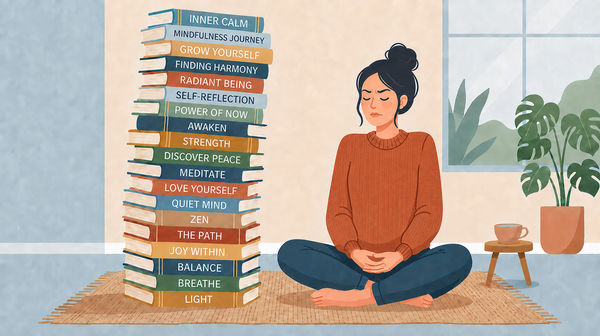
How to Find Grounding in a Chaotic World
Grounding is not about controlling the world around you. It is the practice of returning to your body, your breath, and the present moment.


In Essence
Grounding does not make the world quieter. It helps you find your way back to yourself while life continues moving around you.
When your mind feels scattered, your body feels tense, or your energy feels pulled in too many directions, grounding helps you return to the present moment. It brings your attention back from everything demanding you at once and reconnects you with what is real, steady, and available right now.
What does grounding really mean?
Grounding is the practice of reconnecting with your body, your breath, and the present moment.
It is easy to think of grounding as calming down, but that is only part of it. Grounding is not a command to relax. It is a way of coming back into relationship with yourself when your attention has been pulled outward, upward, or away from your body.
This matters because many people move through daily life in a state of constant mental motion. They are thinking ahead, replaying conversations, managing responsibilities, responding to messages, absorbing other people’s energy, and trying to stay steady while the world keeps asking for more.
From the outside, they may look fine. Inside, they may feel scattered, stretched, or not quite present in their own lives.
Grounding gives the system a way to return.
Why does the world feel so hard to stay grounded in?
Modern life asks for a great deal of attention.
There are screens, notifications, opinions, expectations, tasks, conversations, decisions, news cycles, emotional demands, and invisible pressures. Even ordinary days can carry more stimulation than the body knows how to process with ease.
Sensitive and thoughtful people can feel this deeply. They may notice more, absorb more, anticipate more, and carry more emotional or mental information than they realize. Over time, that can create a sense of being dispersed, as if attention is spread across too many places at once.
When this happens, the nervous system may begin looking for safety through control. The mind tries to organize everything. The body braces. The breath becomes shallow. Small decisions can feel harder than they should.
Grounding interrupts that pattern. It does not remove every demand, but it changes where you are standing inside yourself as you meet them.
How do you know you are ungrounded?
Ungroundedness can show up in subtle ways.
You may feel foggy, restless, easily irritated, or disconnected from your body. You may find yourself overthinking simple choices or feeling pulled into urgency even when nothing immediate is actually happening. Your shoulders, chest, jaw, or stomach may hold tension before your mind has fully registered stress.
You may also notice that you are living mostly in your head. Your thoughts are active, but your body feels far away. You are moving through the day, but not fully inhabiting it.
This is not a personal flaw. It is information.
Your system may be telling you that it needs a moment of contact, orientation, breath, sensation, or stillness. It may not need a complete life overhaul in that moment. It may simply need you to stop abandoning your body while trying to manage everything else.
What does grounding look like in real life?
Grounding does not need to be elaborate.
It can happen in a few seconds when you pause long enough to notice where you are, how your body feels, and what is actually happening in the present moment.
You might feel your feet on the floor. You might take one slower breath and let the exhale be longer than usual. You might notice the temperature of the room, the texture of your clothing, the sound closest to you, or the feeling of your hand resting on your chest.
You can also ground through movement. A slow walk, gentle stretching, washing your hands, stepping outside, or letting sunlight touch your skin can help bring your attention back into the body.
The point is not to perform a perfect grounding practice.
The point is to return.
Why stillness matters
Stillness is not the same as doing nothing.
Stillness gives your system a chance to catch up with itself. It creates space between the stimulus and your response. It allows you to notice what you are actually feeling before reacting from urgency, habit, or overwhelm.
Even a brief moment of stillness can change the quality of the next choice.
You may not solve the whole problem, but you may be able to respond with more clarity. You may not remove the stress, but you may feel less consumed by it. You may not become perfectly calm, but you may remember that you are here, in a body, in this moment, with one next breath available.
That remembering is powerful.
Presence is practical
Presence can sound abstract until you experience how practical it is.
When you are present, you have access to more of yourself. You can notice what is actually happening instead of only reacting to what your mind imagines might happen. You can feel the difference between a real need and a fear-based urgency. You can recognize what is within your control and what is asking to be released, paused, or approached more gently.
Grounding brings you into that kind of presence.
It gives you a place to stand inside yourself, especially when the outer world feels loud.
This is why grounding is not separate from self-trust. The more often you return to yourself, the more your body begins to learn that you are listening. The more you listen, the easier it becomes to notice your own signals before they become overwhelming.
A simple grounding practice
When you feel scattered, pause for a moment and orient yourself gently.
Let your eyes notice the space you are in. Feel the contact between your body and whatever is supporting you. Notice your breath without forcing it to change. Then place your attention on one thing that is true right now.
You might say to yourself:
I am here.
My feet are on the ground.
This is the room I am in.
This is the breath I can take now.
Let it be simple. The practice does not need to impress the mind. It only needs to help the body recognize that you have returned.
What changes when you return to yourself?
Grounding often changes things quietly.
You may notice that your breath deepens. Your thoughts may still be present, but they may feel less tangled. A decision may become simpler because your system is no longer trying to solve it from a state of scattered urgency.
You may also begin to feel more available to your own life.
That is the deeper gift of grounding. It brings you back into contact with what you are actually experiencing. Instead of moving through the day from the neck up, you begin to inhabit your body again. You remember that you are not only a mind managing tasks, but a whole person with needs, signals, feelings, and wisdom.
Returning again and again
Grounding is not something you master once and never need again.
It is a practice of returning.
You will drift into thought. You will get pulled into the pace of the world. You will forget yourself at times. That does not mean you have failed. It means you are human, living inside a world that constantly asks for your attention.
The invitation is not perfection.
The invitation is return.
One breath. One pause. One moment of feeling your body again. One choice to notice what is here instead of abandoning yourself to everything happening around you.
If you paused for thirty seconds today and truly listened to your body, what might it tell you?
Let that question become a doorway.
You do not have to control the world in order to find steadiness.
You can begin by coming back to the place where steadiness first becomes possible.
Where in your day is your body asking you to pause and return to yourself?