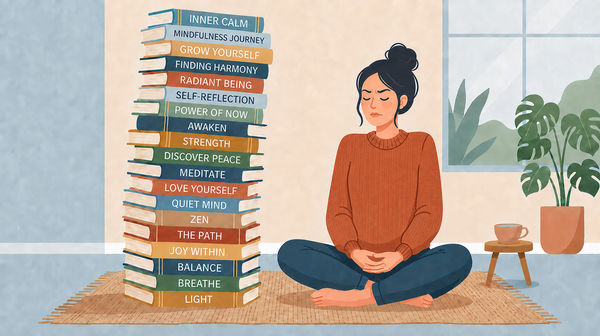
Why You Keep Repeating Patterns and How to Shift
Repeating patterns are not always a sign that you are failing. They may be showing you where awareness, support, and a different response are needed.


In Essence
You can see the pattern. You may understand where it comes from. You may know what needs to change.
And still, the pattern can return.
This does not mean you are failing. It may mean the pattern is not only mental. It may live in your body, your nervous system, your old protections, your relationships, and the ways you learned to stay safe.
Awareness matters, but awareness alone does not always create change. Real change begins when you meet the loop differently.
Why do patterns keep repeating?
There is a moment many people recognize, even if they do not always say it out loud.
Life looks like it is moving forward, but something underneath feels familiar.
You have been here before.
The same thought returns. The same relationship dynamic plays out. The same hesitation appears right when something begins to open. The same fear arrives when you are about to choose something more honest.
You notice it. You understand it. You may even know what you want to do differently.
And still, the pattern comes back.
That can feel frustrating because part of you believes awareness should be enough. Once you see the pattern, it seems like you should be able to stop repeating it.
But patterns often continue because they are not just habits. They are forms of protection, familiarity, identity, and survival that once made sense in a different context.
What do repeating patterns look like?
Old patterns are not always obvious.
They can be subtle.
A familiar thought about yourself that does not feel true, yet keeps showing up.
A relationship dynamic that leaves you in the same emotional place.
A tendency to pull back when something begins to expand.
A habit of avoiding the very thing that could move you forward.
A sense of overwhelm around something that actually matters to you.
A quiet belief that you have to handle everything alone.
Patterns can hide inside ordinary reactions.
You may say you are being practical when you are actually protecting yourself from disappointment. You may say you are waiting for the right time when you are actually afraid to be seen. You may say you are fine when your body has been asking for support.
Recognizing the pattern is not the end of the process.
It is the beginning of a more honest conversation with yourself.
Why does awareness alone not always create change?
Awareness gives you a clearer view, but it does not automatically change the system that has been carrying the pattern.
You can understand something intellectually while still responding from an old emotional imprint.
You can know a boundary is needed and still freeze when it is time to name it. You can recognize a fear and still let it decide. You can see the loop and still feel pulled back into it when your nervous system becomes activated.
This is why judging yourself for repeating a pattern rarely helps.
Judgment adds pressure. Pressure often strengthens the old response. Then the pattern becomes harder to shift because now you are not only caught in the loop, you are also ashamed of being caught.
A more compassionate question is:
What is this pattern trying to protect?
That question creates space.
It allows you to see the pattern not as proof that something is wrong with you, but as information about what still needs care, safety, support, or a different response.
Why do people try to change alone?
Many people carry the belief that they should be able to handle things by themselves.
It can sound strong. Responsible. Independent. Mature.
But in practice, trying to change alone can keep you inside the same perspective that created the loop.
When you are inside a pattern, you are also inside the nervous system state, assumptions, fears, and protective strategies that keep the pattern alive. It becomes difficult to see what else is possible because your whole system is organized around the familiar response.
Support can change the dynamic.
Support may bring:
A lens you cannot access from inside the loop
Steadiness when your system feels activated
Grounded reflection without judgment
A reminder that you are not alone in what you are facing
A different response when the old pattern wants to take over
Support does not mean someone else has the answer for your life.
It means you do not have to keep trying to find your way out of the same pattern with only the same tools that kept you there.
What happens when you allow yourself to be seen?
For many people, the hardest part is not recognizing the pattern.
It is allowing someone safe to see them inside it.
Vulnerability can feel uncomfortable, especially if you are used to being capable, private, composed, or self-sufficient. Letting someone see the place where you feel stuck may feel exposing.
Yet being seen with compassion can soften something.
The pattern may loosen its grip. The shame may become less heavy. A new response may become easier to access because you are no longer carrying the loop in isolation.
Change does not always begin by doing more.
Sometimes it begins when you stop holding everything alone.
What kind of support helps patterns shift?
Support does not have to be dramatic.
It can be simple, direct, and human.
Saying out loud what you have been keeping to yourself
Reaching out to someone you trust
Letting someone reflect what you cannot quite see
Receiving grounded guidance without giving away your inner authority
Having a steady presence while you choose a different response
Allowing yourself to be witnessed without being fixed
Support can be a conversation, a practice, a trusted relationship, a therapist, a guide, a group, a friend, a ritual, a moment of stillness, or any space that helps you return to yourself with more clarity.
The form matters less than the effect.
Does it help you feel more honest, grounded, spacious, and connected to yourself?
If so, it may be support.
How can you begin shifting a repeating pattern?
Begin by slowing down when the pattern appears.
You do not need to solve your whole life in that moment. You only need to create enough space to notice what is happening before the old response takes over completely.
You can ask:
What is the familiar loop here?
What does this pattern usually want me to do?
What feeling or fear is being activated?
What is this pattern trying to protect?
What support would help me choose differently this time?
Then look for one small place where a different response is possible.
A pause before reacting.
A truthful sentence.
A request for support.
A boundary named more clearly.
A willingness to stay present instead of disappearing.
A choice that interrupts the old loop without forcing a total reinvention.
Small interruptions matter.
They teach your system that another way is possible.
A different way can begin here
You notice the pattern.
You pause instead of pushing.
You let yourself be honest about what keeps repeating.
You allow support to meet you there.
From that place, something can begin to shift.
Not all at once, and not through force, but enough for a different response to become available.
Just knowing what needs to change does not always lead to freedom.
Freedom begins when you stop trying to move through the same pattern in the same way.
What support would help you step out of the loop and choose a different response this time?